Quick answer
To convert an oven recipe to an air fryer, reduce the temperature by 15–20 °C (25–35 °F) and the cooking time by 25–35%. If the recipe is written for a fan or convection oven, reduce the time but not the temperature. Glass and ceramic dishes take longer to heat through than metal.
Oven to air fryer calculator
Choose the oven type from the original recipe, enter its temperature and time, and use the result as your starting point.
- Temperature: Reduce by 15–20°C / 25–35°F.
- Time: Reduce by 25–35%.
- Convection: If the recipe is for a fan/convection oven, reduce time but not temperature.
- Cookware: Glass and ceramic dishes take longer to heat through than metal ones.
Taken from the guides in the free AirFryer Master app.
Oven to air fryer conversion chart
Common conventional-oven settings converted with the same rule (temperature −15–20 °C, time −25–35%):
| Oven temperature | Oven time | Air fryer temperature | Air fryer time |
|---|---|---|---|
| 320 °F160 °C | 20 min | 280–290 °F140–145 °C | 13–15 min |
| 360 °F180 °C | 15 min | 320–330 °F160–165 °C | 10–11 min |
| 360 °F180 °C | 30 min | 320–330 °F160–165 °C | 20–23 min |
| 370 °F190 °C | 25 min | 340–350 °F170–175 °C | 16–19 min |
| 390 °F200 °C | 20 min | 360–370 °F180–185 °C | 13–15 min |
| 390 °F200 °C | 40 min | 360–370 °F180–185 °C | 26–30 min |
| 430 °F220 °C | 30 min | 390–400 °F200–205 °C | 20–23 min |
| 450 °F230 °C | 60 min | 410–420 °F210–215 °C | 39–45 min |
Why does an air fryer cook faster than an oven?
The chamber is much smaller and a strong fan moves hot air directly over the food. Heat transfers faster, so the same result needs less heat and less time. That is also why every air fryer behaves slightly differently — always check doneness early the first time you convert a recipe.
How do I convert baking recipes?
Cakes and muffins are the most sensitive to conversion: too hot and the top burns while the middle stays raw.
Baking Temperature Adjustments
Reduce baking temperature by 15–20°C/25–35°F compared to a conventional oven to avoid a burnt top and raw centre. Air fryers cook more efficiently due to rapid air circulation. Also reduce cooking time by about 20%. Check doneness earlier than the recipe suggests. Use a toothpick test for cakes and muffins—it should come out clean or with a few moist crumbs.
The Foil Helper Technique
If the top of baked goods or casseroles browns too quickly, cover with a sheet of aluminium foil during the second half of cooking. This reflects heat away from the surface while allowing the interior to cook through. Make sure the foil doesn't touch the heating element. Remove foil for the last 2-3 minutes if you want a golden top.
20 tips like these, plus step-by-step recipes, are in the free app.
What about thick cuts of meat?
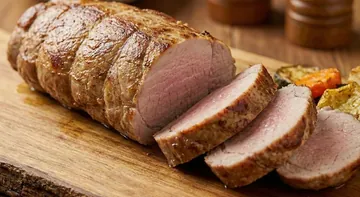
For roasts and thick chops, the clock is only a guide. Use a thermometer and go by internal temperature — the app lists it for every meat recipe, for example 145 °F / 63 °C for pork tenderloin or 165 °F / 74 °C for chicken breast. Let the meat rest for 5–10 minutes before cutting.
Internal temperatures for 50+ foods are in the cheat sheet.
Frequently asked questions
What is 350 °F in an air fryer?
Reduce it by 25–35 °F, so roughly 315–325 °F, and cut the time by 25–35%. For a fan-oven recipe, keep 350 °F and only shorten the time.
What is 200 °C in an air fryer?
About 180–185 °C, with 25–35% less time than the oven recipe. A 40-minute oven dish becomes roughly 26–30 minutes.
Do I need to reduce the temperature for a convection oven recipe?
No. Convection ovens already use a fan, so keep the temperature and only reduce the cooking time.
Can I use my oven dishes in the air fryer?
Yes, if they fit with space around them for air. Glass and ceramic dishes take longer to heat through than metal ones, so allow a little extra time.